Make the system legible
Whether it is a UI migration or a product workflow, I try to expose the real structure so teams can make decisions without guesswork.
Field notes from a software engineer
I turn dense product systems into calm, dependable interfaces.
I'm DC, a frontend engineer at HubSpot with a systems brain.
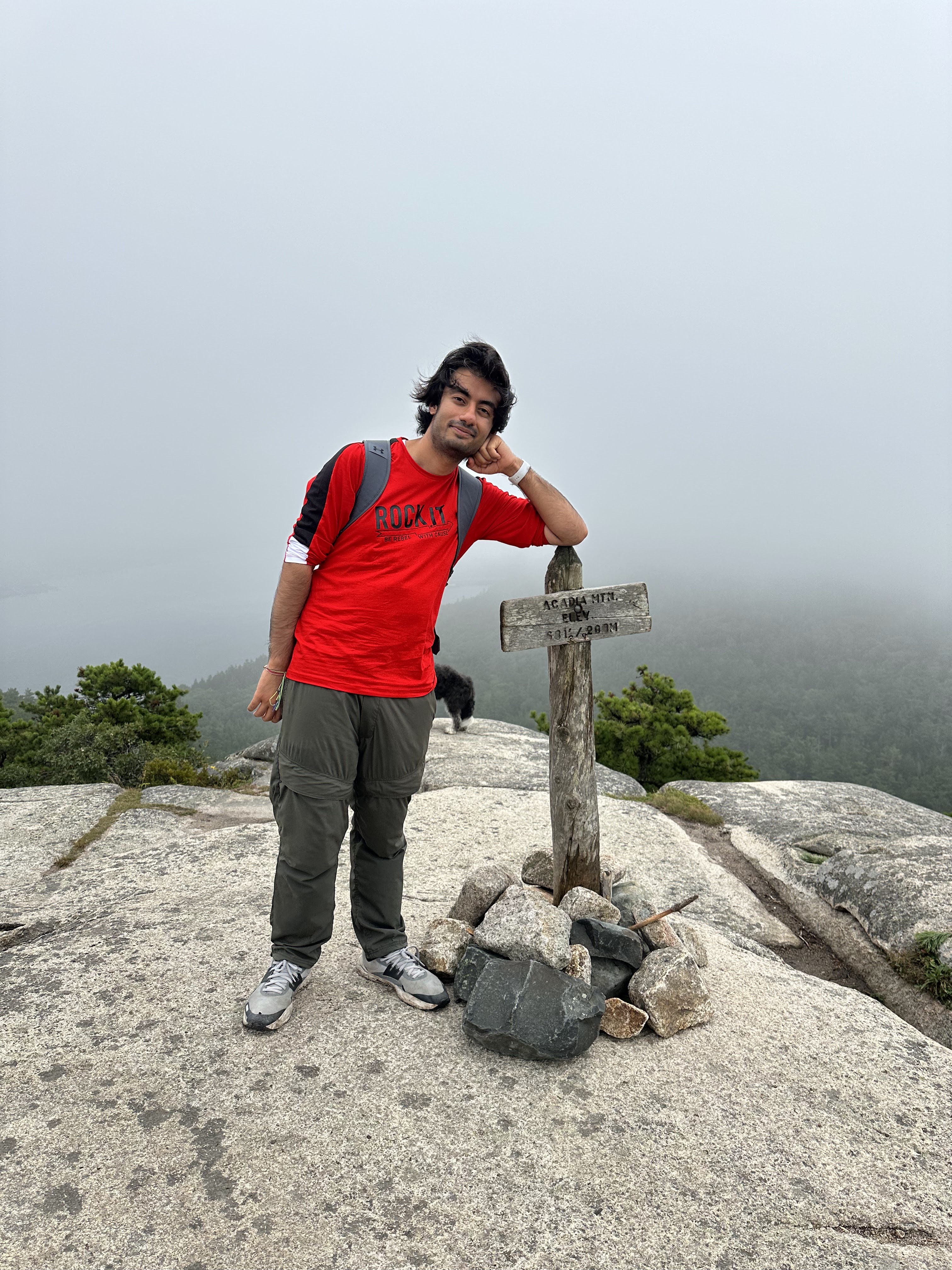
A hiking photo because most of my best thinking happens away from a screen.
I did not plan a straight line. I kept following the hard problems and built taste in the process.
Origin Note
The thread through my work is pretty consistent, and I like walking into complicated systems, finding the shape underneath the mess, and making the next person feel less friction than I did.
That has taken a few forms, including migration tooling at HubSpot, security workflows at Tesla, design systems at Walmart, CPQ flows at Salesforce, and earlier research in computer vision. Different domains, same instinct.
I care about software that feels thoughtful in the small moments, where clearer states, fewer confusing paths, better defaults, sharper feedback, and codebases give teams room to move.
Whether it is a UI migration or a product workflow, I try to expose the real structure so teams can make decisions without guesswork.
I am happiest when engineering details disappear into an interface that feels obvious, fast, and hard to misuse.
Docs, codemods, component stories, lint rules, and dashboards are all part of the same habit, which is to help the next person move faster.
Every role changed the domain. The underlying instinct stayed the same.
Chapters
HubSpot
Aug 2024 - Present
Frontend systems, codemods, migration guidance
Leading frontend migration work at HubSpot, I built TypeScript and Node.js codemods that moved 200+ apps to a modern UI library, cutting manual effort by 60% and saving about four months. I also improved a plugin-based ESLint workflow that surfaced migration guidance and deadlines, reducing tracking overhead and migration errors across teams.

Tesla
Jun 2023 - Jun 2024
Global rollout, role-based workflows, multilingual UI
Tesla Watchlist became my core focus, and I helped lead its global rollout to 1000+ locations used by 2500+ Security and HR stakeholders. I built the frontend architecture with React, TypeScript, Express, Webpack, and Redux, and delivered 10+ features, including role-based flows and multilingual support, driving strong QoQ adoption.

Walmart
May 2022 - Aug 2022
Design systems, Storybook, component audits
During my Walmart internship, I built a React + TypeScript design library with Nx and Storybook to improve UI consistency and team velocity. I documented 25+ interactive component stories and automated component audits, reducing maintenance overhead and making frontend development more predictable.

Salesforce
Jun 2020 - Jul 2021
React flows, SDK integration, release quality
My AMTS role at Salesforce centered on a B2B CPQ platform spanning UI work, SDK integration, and release testing. I delivered key React/TypeScript product flows and supported Java/Spring Boot optimizations that improved API response times by 25%.
Salesforce
May 2019 - Aug 2019
Monitoring, analytics, operational dashboards
As a Salesforce intern, I built a Python-based anomaly monitoring pipeline to improve visibility into database host health. I also created an analytics dashboard using Einstein integrations and actionable widgets, giving internal teams clearer operational insight.
The interesting part of a project is the tradeoff you made when nobody was watching.
Case Files
The one about coordination and dignity.
How do you make support delivery easier without making the process feel cold?
Built a TrojanHacks web app for unhoused and low-income individuals in LA to find nearby shelters and charity events through SMS, so access did not depend on always having an internet connection. The system supported donor-created charity events, authority validation flows, map-based location views, and two-way Twilio messaging for registration and RSVPs.
This is where I started thinking less about screens and more about the human handoff behind them: who needs help, who can offer it, and what the system has to coordinate between them.
The one where strategy became code.
What does good decision-making look like when the board is small but the branching factor is not?
Developed an AI agent for 5x5 Go using minimax with alpha-beta pruning and reinforcement-learning approaches; achieved a 100% win rate against random/aggressive/greedy/minimax baselines and an overall 95.9% win rate.
A small board turned into a clean lesson in search, tradeoffs, and knowing when a model has enough information to act.
The one that pulled research into the road.
What does a support system need to notice before the human does?
As part of my final-year B.Tech project, I developed four AV support modules, including pothole detection, traffic light signal/counter detection, potential vehicle-to-animal accident detection, and vehicular accident detection.
It taught me to think in failure states, including what needs to be noticed, when, and how clearly the system should respond.
The hackathon one.
Can a model read a scene well enough to turn it into shareable language?
Built a deep-learning engine that analyzes image scenes and generates Instagram-ready hashtags; won the Makerswave hackathon organized by Innovation Garage at NIT Warangal.
Fast prototypes are useful when they make the idea tangible enough for people to react to.
Workbench
I use tools as leverage for clearer product behavior, where faster feedback loops, better migrations, fewer ambiguous states, and interfaces teams can keep improving.
The throughline is reliability, with predictable components, sensible defaults, and debugging paths that are obvious at 2 AM.
On the frontend, that means React and TypeScript patterns that make states legible, CSS that behaves across screens, and tests that keep the interface honest as it grows.
The AI/ML side comes from earlier work in computer vision, NLP, reinforcement learning, and search. It keeps me comfortable around ambiguity, signals, and systems that need to make careful decisions with incomplete information.
Different tools, same instinct, which is to make complexity easier to use.
Research Wall
My early work sat at the intersection of computer vision, road safety, and autonomous vehicle support systems. That research background still shapes how I think about signals, edge cases, and feedback loops in product interfaces.
Earnest Paul Ijjina, Dhananjai Chand, Savyasachi Gupta, Goutham K
A road-accident detection framework for traffic surveillance footage using Mask R-CNN object detection, centroid-based tracking, and trajectory anomaly analysis.
Dhananjai Chand, Savyasachi Gupta, Ilaiah Kavati
A dashboard-camera support system for self-driving cars that tracks vehicles and analyzes speed, acceleration, and trajectory signals to detect accidents.
Savyasachi Gupta, Dhananjai Chand, Ilaiah Kavati
A driverless-vehicle support framework that detects animals in dashcam video, checks lane obstruction, and tracks animal movement to reduce collision risk.
Dhananjai Chand, Savyasachi Gupta, Ilaiah Kavati
A traffic signal and countdown timer detection framework for autonomous vehicles, combining Mask R-CNN object detection with image processing and RetinaNet-based timer recognition.
Education
Master's degree, Computer Science
4.0
Bachelor of Technology, Computer Science and Engineering
8.72/10
Open Channel
Reach out for frontend engineering opportunities, product collaboration, or a good conversation about making complicated tools feel easier to use.
Prefer email? dcdevdhan@gmail.com